


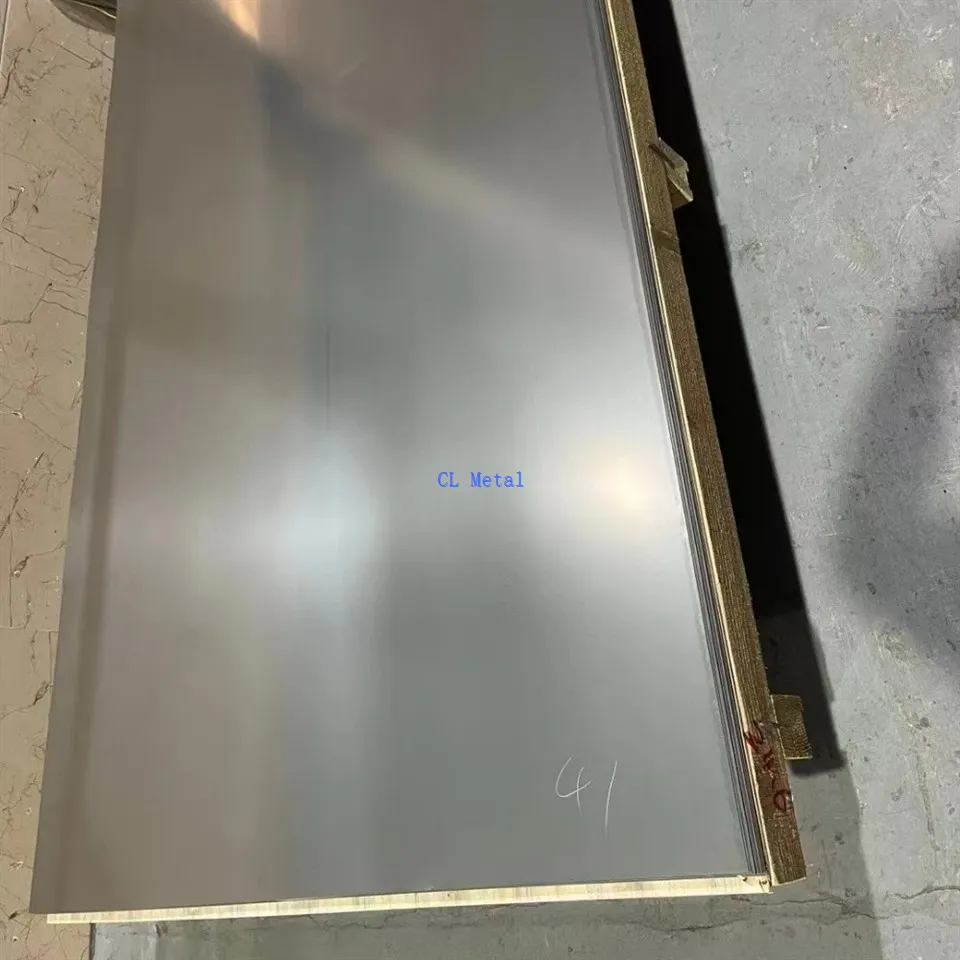


Metal analysis of nickel-based alloy NiCrNbMo sheet:
Composition and microstructure
Chemical composition: Based on nickel (>50%), chromium (18%-21%) forms an oxide film for corrosion resistance, molybdenum (4%-5%) strengthens intergranular strength, and niobium (0.9%-1.9%) achieves a dual strengthening mechanism.
Microstructure: Face-centered cubic austenite matrix, low carbon design (C ≤ 0.10%) avoids intergranular corrosion, and intergranular carbides inhibit dislocation movement. Core chemical composition and microstructure
Synergistic effect of multiple elements: Nickel (>50%) as the matrix provides high-temperature stability, chromium (18%-21%) forms Cr₂O₃ oxide film for corrosion resistance, molybdenum (4%-5%) enhances intergranular strength, and niobium (0.9%-1.9%) achieves dual strengthening through γ''-Ni₃Nb phase.
Austenite matrix: The face-centered cubic structure gives low magnetic permeability (μ ≤ 1.05 μΩ·m) and low thermal expansion coefficient (15.9×10⁻⁶/K), suitable for quantum computing and deep space exploration.
Extreme environment performance
High-temperature mechanics: Tensile strength ≥ 650 MPa at 600°C, creep resistance strength up to 150 MPa at 1000°C (three times that of stainless steel), after eliminating intergranular defects through directional solidification process, turbine blades of aircraft engines can withstand 1600°C gas erosion.
Corrosion resistance: PREN index exceeds 35, corrosion rate in boiling sulfuric acid is < 0.1 mm, anti-stress corrosion performance in H₂S + H₂ mixed gas environment is 10 times higher than 304 stainless steel.
Process compatibility: Supports selective laser melting (SLM) additive manufacturing, material utilization rate reaches 80%, weld joint strength reaches 90% of the base material.
Key production process
Smelting and roughing: Dual process of VIM + ESR ensures oxygen content < 20 ppm, high-temperature homogenization treatment eliminates dendritic segregation.
Rolling and heat treatment: Multiple fire passes (compression ratio ≥ 3.0) combined with Zr grain refiner, surface roughness Ra ≤ 1.6 μm; solution treatment (1150-1200°C water quenching) restores plasticity, aging treatment (700-850°C) precipitates γ'' phase to enhance hardness (HRC 28-32).
The performance advantages of nickel-based alloy NiCrNbMo sheet
High-temperature performance: Tensile strength ≥ 650 MPa at 600℃, creep resistance strength up to 150 MPa at 1000℃ (three times that of stainless steel).
Corrosion resistance: Corrosion rate in boiling sulfuric acid is less than 0.1 mm per year, and the point corrosion resistance index (PREN) exceeds 35.
Process compatibility: Supports vacuum melting, isothermal forging, and laser additive manufacturing. The strength of the welding joint is 90% of the base material.
Application fields
Aerospace: Turbine blades and combustion chambers of aircraft engines, capable of withstanding temperatures up to 1100℃.
Energy equipment: Heat transfer tubes of nuclear power steam generators, resistant to chloride stress corrosion.
Chemical and marine: Heat exchanger tubes for seawater desalination, with a corrosion rate of less than 0.05 mm per year.
Future trends
Component design: Optimizes element ratios through CALPHAD technology, aiming to increase the target operating temperature to 1300℃.
Emerging fields: Support for quantum computing superconducting magnets, materials for new energy vehicle battery enclosures.
This material, with its high-temperature resistance, corrosion resistance, and ease of processing, has become a key strategic material in extreme environments, promoting the development of independent control of high-end equipment. Emerging fields: Quantum computing superconducting magnet support (low magnetic permeability), new energy vehicle battery enclosure materials (impact resistance), Mars rover thermal control system (temperature range from -150℃ to 120℃).
Component design: Optimizes the ratios of niobium and molybdenum through CALPHAD technology, aiming to increase the target operating temperature to 1300℃.
Process innovation: Digital twin technology increases the yield to 85%, and the fluorine-free acid washing process reduces wastewater discharge.
Through continuous breakthroughs in component design and process, nickel-based alloy NiCrNbMo sheet is moving from traditional industrial materials to cutting-edge fields such as quantum technology, supporting technological innovation in extreme environments.

why choose us

What are the typical application cases of NiCrNbMo plates?
Aerospace engine turbine blades: Under the impact of high-temperature gas at up to 1100°C and centrifugal force at 300m/s, the high-temperature strength and creep resistance (tensile strength ≥ 650MPa at 600°C) of the NiCrNbMo sheet ensure the long-term stable operation of the blades, with a service life of over 10,000 hours.
Combustion chamber flame tube: Its thermal shock fatigue resistance enables it to withstand frequent thermal shocks from high temperature, high pressure, and high-speed airflow, preventing crack formation.
Rocket nozzle expansion section: Its high hardness and wear resistance enable it to resist the erosion of high-temperature and high-speed particles, ensuring the accuracy of the nozzle shape and thrust efficiency.
Nuclear power steam generator heat transfer tubes: In a high-pressure environment of 350°C and 15MPa, and with chloride ions, its stress corrosion resistance is more than 10 times higher than that of 304 stainless steel, with a service life of up to 40 years.
Gas turbine turbine disk: It can operate stably for 5,000 hours under a cyclic stress of 700°C and 100MPa without fatigue cracks.
Hydrogen energy compressor sealing components: Their low-temperature toughness (-253°C) and anti-hydrogen embrittlement performance ensure reliable sealing in extremely low-temperature and high-pressure hydrogen environments.
Chemical reactor inner walls: Welding NiCrNbMo sheets can resist strong corrosive media such as concentrated sulfuric acid and hydrochloric acid, with a lifespan that is five times longer than ordinary stainless steel.
Seam bundle of seawater desalination device condenser: The annual corrosion rate in seawater containing 2000ppm Cl⁻ is less than 0.05mm, and it is resistant to microbial induced corrosion (MIC).
Petroleum hydrogenation reactor lining: It is resistant to sulfide corrosion in a mixed gas of H₂S + H₂ at 450°C and 20MPa, reducing the frequency of shutdown and maintenance.
New energy vehicle battery pack shell: Lightweight (density 8.2g/cm³) with anti-collision and high-temperature abuse resistance, enhancing safety.
Mars rover thermal control system heat exchanger: Tolerant to extreme temperature difference cycles of -150°C to 120°C, ensuring stable operation of equipment in extreme environments.
Hot Tags: nickel-based alloy nicrnbmo sheet, China nickel-based alloy nicrnbmo sheet manufacturers, suppliers, factory, nickel, Nickel Foil Material


