


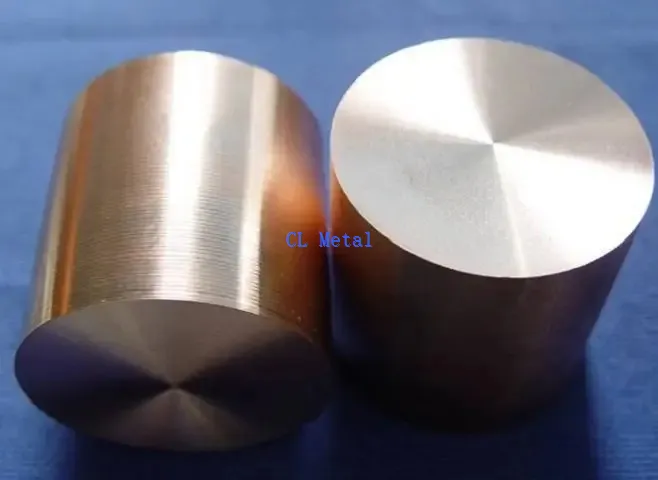
Tungsten Copper Alloy combines a refractory tungsten framework with copper to serve electrical, thermal and wear-related duties that neither constituent handles in the same way alone. It is commonly considered for resistance-welding and electrical-discharge electrodes, power contacts, arc-exposed components, heat-spreading inserts and compact machined parts. Tungsten contributes resistance to heat and erosion at the working face, while copper provides a conductive path for current and heat. The useful balance depends on the part, so the alloy is purchased by an identified tungsten-copper composition rather than by the family name alone.
Application geometry determines whether that balance becomes useful hardware. An electrode needs a stable working tip, a current path, a holder interface and often a route for heat removal. A thermal component depends on contact area, attachment and cooling beyond the alloy itself. Tungsten Copper Alloy can be supplied as plate, bar, block, cut blank or a drawing-based finished component. Starting with composition, delivery form and functional surfaces produces a clearer order than treating the material as ordinary copper stock.

The W-Cu Balance Changes the Part
A composition selected for an erosion-facing electrode may not be the preferred composition for a heat spreader or contact. Increasing the tungsten share generally emphasizes the refractory skeleton and mass, while increasing the copper share changes conductive behavior and the way the composite responds during machining and joining. That relationship is why a request for "copper tungsten" without an approved ratio is incomplete. The order can name a recognized project grade, an explicit constituent balance, or a previously qualified material record.
Property language also needs to remain specific. Electrical conductivity and thermal conductivity are different measurements; density can help characterize a composite but cannot replace composition identification. When a property is important to incoming acceptance, the enquiry should state which property is being assessed and how the result will be used. Otherwise, broad data-sheet figures can be mistaken for guarantees on a finished electrode operating under an unreported current, pressure or cooling condition.
| Part duty | Material question | Geometry that deserves attention |
|---|---|---|
| Discharge electrode | Approved W-Cu balance and erosion priority | Tip profile, flushing features and holder interface |
| Electrical contact | Conductive path and arc exposure | Contact face, backing connection and alignment |
| Thermal insert | Heat-flow and expansion objective | Mating area, thickness and attachment land |
| Dense machined part | Mass, machinability and service environment | Pockets, thin edges, bores and datums |
Electrodes Work as Complete Current Paths
For an electrode, the working face is one element within the design. Current enters through a shank, clamp or threaded connection, passes through the alloy and reaches a defined contact area. Heat then leaves through the body, holder or cooling arrangement. Misalignment, insufficient contact pressure or a poor backing interface can overwhelm a carefully selected material. A useful electrode drawing therefore identifies the face that performs the work, the seating surface that transfers current and heat, and the features that locate the part.
Replacement electrodes deserve more than a tracing of the worn tip. Erosion can remove the original contour and make a used sample shorter, rounded or asymmetric. Where no controlled drawing exists, dimensions should be taken from unworn locating areas and the intended tip shape should be reconstructed from equipment records or a qualified new part. The machining scope can then include the agreed profile without presenting wear as design intent.
Blank Size Should Follow the Machining Route
Stock form affects yield. A rectangular electrode body may begin economically from plate or block, while a round shank can favor bar or a near-size blank. Specify the delivered envelope, allowance on each face and any orientation that matters to later work. If the order is for a completed part, provide the revision-controlled drawing with datums, threads, holes, radii, edge breaks and surface requirements attached to their actual functions.
Tungsten copper is a composite, so cutting behavior should not be assumed from experience with pure copper or monolithic tungsten. Secure workholding helps protect corners and small details. Deep narrow slots, tiny threads, sharp internal corners and thin walls can dominate feasibility even when the outer dimensions appear simple. Early review of these features can identify a practical tool path and prevent unnecessary finish demands on surfaces that will never contact another component.

Attachment Surfaces Need Their Own Definition
Brazed, soldered, plated, bonded and mechanically clamped interfaces impose different surface needs. Mark the joining areas on the drawing and describe the mating material and process route. A roughness requirement may be valuable on a contact or sealing land yet pointless on an exterior face. Where plating is part of the purchased component, coverage and masked regions must be unambiguous; where the customer applies it later, the incoming surface should suit that qualified preparation sequence.
Material alternatives should be compared by function rather than by their shared copper content. Molybdenum Copper Alloy is often evaluated for expansion-managed thermal substrates. A design that requires the refractory behavior of tungsten without intentional copper may instead begin with Tungsten Plate. Changing among these materials alters more than a line on the bill of materials.
Acceptance Should Follow the Supplied Stage
For a raw blank, practical receiving checks include material identity, the agreed composition evidence, delivered dimensions, visible condition and lot marking. A finished component adds drawing-linked inspection of the features that control fit or function. Conductivity, density or other property testing adds value when an order defines the method and acceptance basis. Electrode life, arc stability and assembly temperature remain results of the operating system rather than simple incoming measurements.
| Supply stage | Useful release information | Protection in transit |
|---|---|---|
| Plate, bar or block | Composition, envelope, quantity and usable allowance | Separated pieces and supported corners |
| Cut blank | Cut dimensions, retained stock and lot identification | Restraint against high-mass impact |
| Machined electrode | Drawing, datums, tip geometry and inspection points | Caps or cavities protecting working faces |
| Joined or plated part | Interface map, included process and finish checks | Nonabrasive wrapping on prepared surfaces |
Compact tungsten copper pieces can be deceptively heavy. Packaging should immobilize them so adjacent parts cannot strike threads, edges or contact lands. Individual labels or tray-level identification can retain the part number, lot and quantity. Clean protection is especially important when a prepared surface will enter a joining operation soon after receipt.
Questions From Tungsten Copper Buyers
How is the right tungsten-copper composition selected?
The choice comes from the part's approved balance of conductivity, erosion exposure, mass, expansion behavior and machining needs. A previous qualified drawing is often the best starting reference; an application label by itself is not enough.
Can density be used as the only incoming test?
Density may support composite control, but it cannot identify every aspect of composition or prove electrical performance. Use it alongside the material records and dimensional checks relevant to the order.
Is a machined electrode preferable to buying a blank?
That depends on available tooling, quantity and control of the working geometry. Finished supply can combine material and dimensional responsibility, while blanks give an experienced machine shop direct control over its established process.
What details are needed for a brazed tungsten copper part?
Show the joint location, mating material, clearance concept, surface area, filler or project process where defined, thermal cycle ownership and any finish applied before brazing. Representative assembly trials remain important for a new joint.
Information for a Focused Quotation
Identify Tungsten Copper Alloy, the approved W-Cu balance, product form, blank or final dimensions, quantity and drawing revision. Add the component role, critical electrical or thermal faces, machining boundary, joining or plating scope, inspection methods, documentation and destination. When the part is an electrode, include its holder connection and working-face geometry. When it is a thermal component, show the mating interfaces and attachment route. These details allow the offer to distinguish raw material from a finished functional component without filling gaps with unsupported assumptions.
Hot Tags: tungsten copper alloy, China tungsten copper alloy manufacturers, suppliers, factory, red tungsten for aluminum, Tungsten Copper Alloy, tin tungsten, best tungsten for mild steel, tungsten metal for sale, molybdenum and tungsten


