


Grade 1 Titanium Rod is commercially pure titanium round stock for components that place a premium on formability and corrosion-conscious design rather than high alloy strength. It can become bent supports, upset details, pins, fasteners, spacers, shafts with modest loads, and machined process hardware. The grade is attractive when the fabrication route includes meaningful deformation, yet its ductility does not make every radius or reduction automatically workable. Diameter, condition, surface, tooling, and final section determine the practical forming window.
The rod also has to satisfy the completed component, not only the forming step. Service medium, contact materials, wear surfaces, threads, and applied loads remain part of selection. A request for pure titanium does not define Grade 1, and a request for rod does not say whether full lengths, cut blanks, ground stock, or finished pieces are wanted. Clear purchasing language brings those choices together: approved material identity, starting geometry, conversion route, lot evidence, and the protection needed to preserve straightness and clean surfaces through delivery.

Formability Has to Serve the Final Load
Grade 1 is often considered when bending, upsetting, swaging, or another forming operation is central to the part. Begin with the final drawing and identify the zones undergoing the greatest change. Starting diameter, bend radius, reduction, direction, tool contact, and sequence all influence the result. Surface marking and springback may be as important as visible cracking when a formed area locates another component.
The lower-strength choice remains subject to stress, stiffness, fatigue, and wear review. A readily formed rod is not a universal shaft material, and it should not replace a stronger titanium grade merely to simplify production. When the finished component cannot meet its mechanical duty in Grade 1, the answer is a material and process reassessment rather than forcing extra capacity from the incoming rod.
| Fabrication path | Part information to release | Result to observe |
|---|---|---|
| Bending | Radius, angle, orientation, contact faces | Shape recovery, marks, local section |
| Upsetting or swaging | Starting and finished envelope, reduction sequence | Flow into the desired geometry |
| Machining | Datums, bores, threads, cleanup allowance | Recoverable dimensions and retained surface |
| Joining | Joint layout, mating grade, preparation scope | Fit-up under the qualified procedure |
| Assembly | Loads, contacts, process exposure | Suitability of the completed component |
Decide How Much Conversion Belongs in Supply
Full rod gives the purchaser control over blanking and process sequence. Cut lengths remove a routine operation but require end condition and traceability to be specified. Peeled or ground stock can be valuable when the outside diameter remains functional or feeds a precision operation. A completely machined component shifts the order to drawing acceptance and needs feature-level inspection rather than bar-level limits alone.
Diameter, overall length, and straightness need to suit the first fixture as well as the final part. Long pieces should have a repeatable support arrangement for straightness measurement. Stock intended for broad roughing usually does not benefit from finished-shaft tolerances. Conversely, a near-net blank may require close control where little material remains available for cleanup.
Plan Forming Before Close Machining
When one part is both bent and machined, the order of operations affects datums and allowance. Forming can move the centerline, alter an end position, or mark a surface. Close features created too early may no longer relate correctly after deformation. A prototype route can establish where extra stock is useful and which dimensions should be finished after the rod takes its final shape.
Joining introduces its own preparation, shielding, cleanliness, filler, and procedure controls. Material conformance for the rod does not approve the welded assembly. Similarly, corrosion behavior depends on the full fabricated geometry, including crevices, deposits, cleaning chemicals, and dissimilar-metal contacts. Record those conditions when the product is intended for a wetted component.
Compare the Neighboring Product Forms
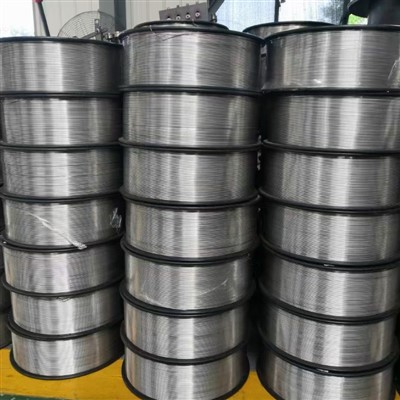
Small wound, woven, or repeatedly bent elements may be better served by Grade 1 Titanium Wire. Using wire instead of rod affects straightening, package behavior, and dimensional control, so the form should follow the conversion route. A solid part needing higher strength can instead be compared with Grade 5 Titanium Rod, with the alloy change also reflected in forming plans and material evidence.
These options are not a hierarchy of better and worse titanium. They solve different combinations of section size, deformation, final load, and machining. Quotations are easiest to compare when the approved form is fixed and any alternate is shown separately with the technical consequences visible.
| Item to preserve | Control at shipment | Receiving benefit |
|---|---|---|
| Lot identity | Transferred marks or a piece-to-lot map | Keeps certificates linked after cutting |
| Straightness | Rigid base and distributed restraint | Reduces handling-induced bend |
| Prepared ends | Separated caps or noncontact protection | Prevents impact at threads and centers |
| Ground surface | Dividers that stop metal-to-metal rubbing | Preserves the supplied finish |
| Part revision | Labels with item and drawing reference | Avoids mixing visually similar pieces |
Questions Before Buying Grade 1 Rod
Why specify Grade 1 instead of pure titanium?
Grade 1 identifies a defined commercially pure grade under the project's material basis. Pure titanium is a broad description and does not establish the required product condition or acceptance evidence.
Can the rod be cold bent after delivery?
It is a formable titanium option, but feasibility remains tied to size, material state, radius, deformation path, tooling, and surface. Validate the intended bend on representative stock.
Is ground bar always preferable for a machined part?
No. Ground supply adds value when its diameter or surface is used by the next operation. If the complete circumference will be rough turned, less processed stock may be more economical.
What is the best way to identify small cut blanks?
Use labeled compartments, controlled bundles, or travelers when direct marks would harm the part. The packing list should map each group to its source lot and drawing item.
Describe the Rod and Its Next Operation
An effective request names Grade 1 Titanium Rod, material basis, condition, starting form, diameter, tolerance, length, straightness method, ends, surface, quantity, and delivery timing. Add the component drawing, forming steps, machining allowances, joining scope, operating exposure, inspection, lot transfer, marking restrictions, and packing configuration. The result is a quotation for a defined fabrication input, with finished-part qualification kept at the correct stage.
Hot Tags: Grade 1 Titanium Rod, China Grade 1 Titanium Rod manufacturers, suppliers, factory, cutting titanium, titanium quartz, titanium dioxide co to, titanium mineral, titanium bullion, titanium crystal


